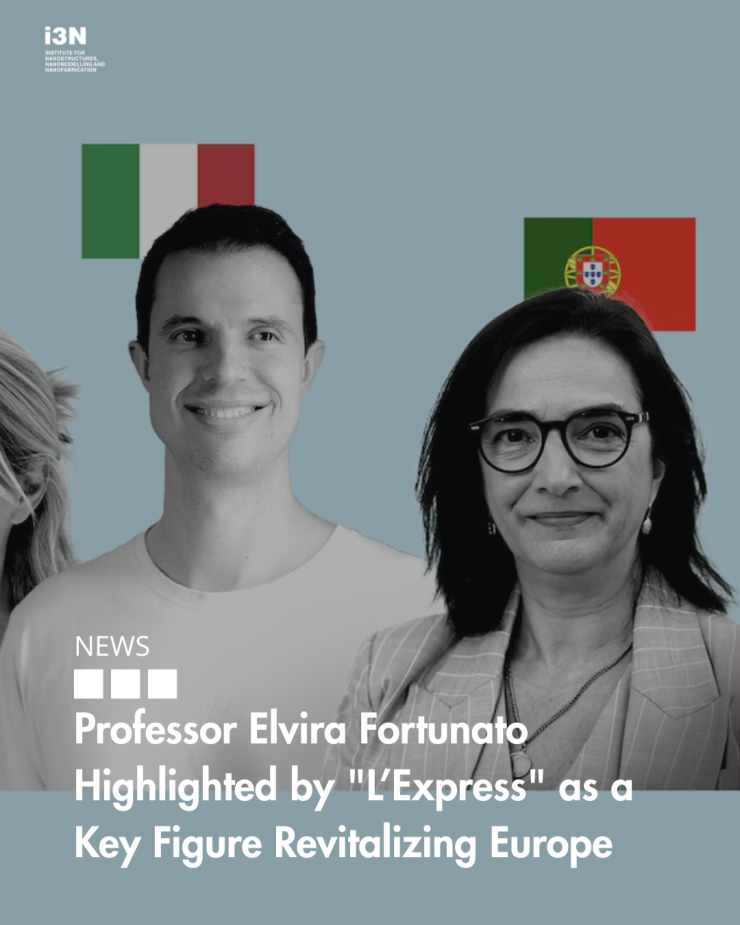
Professor Elvira Fortunato has been featured by the prominent French magazine L’Express as one of four exceptional European figures driving the continent's resurgence. The article showcases four exceptional figures who are shaping an ambitious, resilient Europe a decade after the economic crisis. Alongside tech and cultural leaders from Italy, Spain, and Greece, Professor Fortunato is celebrated for making Europe "hold its head high" through groundbreaking scientific innovation.
A decade after the financial crisis that heavily impacted Southern Europe, L’Express emphasizes that countries like Portugal are redefining their economies far beyond traditional sectors like tourism. The response to adversity, the authors note, has been driven by agility, talent, and inventiveness - qualities epitomized by Professor Fortunato’s career.
Read the full article here.
The profile traces Professor Fortunato’s inspiring journey. Born under the Portuguese dictatorship a decade before the 1974 Carnation Revolution, she grew up in Almada at a time when the country's educational standards were among the lowest in Europe. Rising from a modest family without university degrees, she was driven by a deep intellectual curiosity and the core belief that "education is the key to freedom." Her scientific vision materialized at the NOVA FCT, allowing her to conduct world-class research and develop globally recognized projects - most notably, her flagship invention: the paper transistor.
"We have demonstrated, for the first time, that cellulose – one of the most abundant and renewable materials on Earth – can function not only as a substrate but also as an active component of a transistor." > – Professor Elvira Fortunato
This breakthrough has paved the way for a new generation of low-cost, flexible, and biodegradable electronic devices, such as eco-friendly RFID tags for inventory and airport luggage tracking.
Her international success eventually led her to serve as Portugal's Minister for Science, Technology and Higher Education (2022–2024), where she utilized European funds to improve student housing and reduce the precariousness of research positions.
Reflecting on the budget sacrifices Portugal faced during past crises, Professor Fortunato remains an ardent defender of scientific funding, noting that "investment in knowledge, innovation, and talent enables societies to recover and become more competitive." L’Express beautifully describes the scientist as a "devotee of the telescope" in the historic land of Magellan. Looking forward, she firmly believes that the future of Portugal lies in the study of the oceans and space exploration: "Portugal can contribute, once again, to an era of great discoveries."